
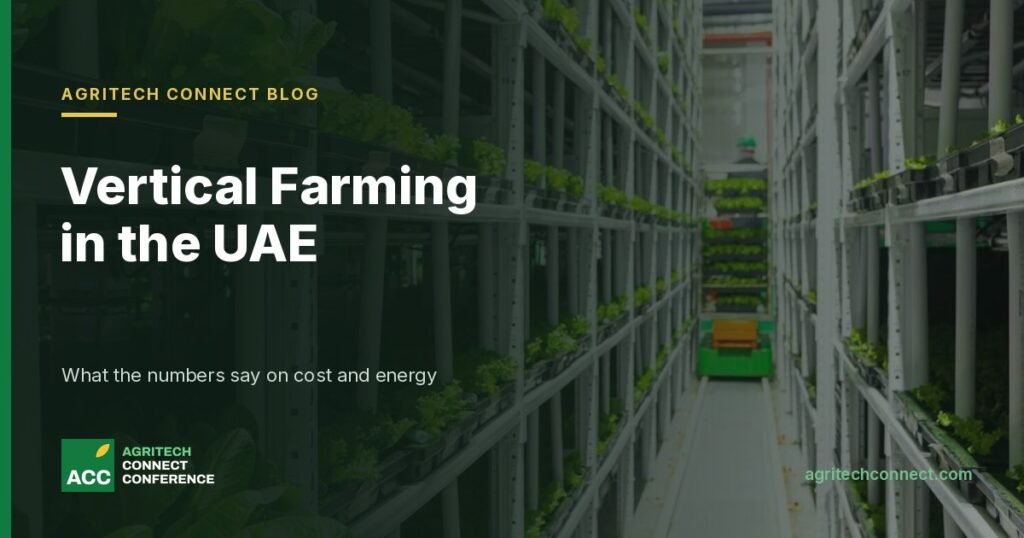
Vertical farming in the UAE has moved from pilot to working scale. The country hosts one of the largest commercial indoor farms in the world, a major research farm in Abu Dhabi and a government incentive programme that has paid to bring growers in. The case for growing leafy greens indoors in a country with almost no fresh water is easy to make. The harder question is what it costs, and above all how much electricity it takes.
This article sets out what has been built, what the research says about energy, water and yields, how vertical farms compare with greenhouses in a hot climate, and why several well-funded companies abroad have failed. Figures are sourced, company claims are labelled, and where we have done our own arithmetic we say so.
What is a vertical farm?
A vertical farm grows crops in stacked layers inside a closed, insulated building. Plants usually grow in hydroponics (roots in a nutrient solution rather than soil), under LED lights, with temperature, humidity and carbon dioxide controlled by machines. Nothing depends on sunlight or the weather outside.
It is one branch of controlled-environment agriculture, the wider family that also includes high-tech greenhouses. The difference matters: a greenhouse uses free sunlight but has to fight the outside heat, while a vertical farm buys all of its light as electricity but is easier to keep cool.
Vertical farming in the UAE today
1. Bustanica, Dubai
Bustanica opened in July 2022 near Al Maktoum International Airport as a US$40 million joint venture between Emirates Flight Catering and Crop One. It covers 330,000 square feet and is designed to produce more than 1 million kg of leafy greens a year, about 3,000 kg a day. The company says it uses 95% less water than conventional farming and saves 250 million litres a year (Gulf News).
In February 2024 Emirates Flight Catering took full ownership of the farm. Its lettuce, spinach, parsley and kale are sold through supermarkets including Spinneys, Waitrose, Carrefour and Choithrams, and served on Emirates flights (Food Business MEA).
2. AeroFarms AgX, Abu Dhabi
In February 2023 AeroFarms opened a 65,000-square-foot research farm in Mussafah, its first indoor vertical farm outside the United States, with support from the Abu Dhabi Investment Office (ADIO). It is a research site, not a commercial one: the company said at the opening that it was not producing for sale there. Work includes crop genetics and seedling quality with Silal, with tomatoes and peppers as target crops (Khaleej Times).
3. Public incentives
AeroFarms came through ADIO’s AgTech Incentive Programme. In April 2020 ADIO committed about US$100 million to four companies, including AeroFarms and the UAE’s Madar Farms, which planned an LED-lit indoor tomato farm (Just Food). Public money has lowered the entry cost. It has not removed the need for each farm to cover its running costs.
What the numbers say on energy
The most useful recent summary is a 2025 review in Agronomy for Sustainable Development by Pennisi, Gianquinto, Marcelis, Martin and Orsini, which pulls together published studies and company data (Pennisi et al., 2025). Its central figures for lettuce are below.
| Measure (lettuce) | Reported value | Roughly equivalent to |
|---|---|---|
| Energy use efficiency, published studies | 0.13 kg per kWh (average) | 7.7 kWh per kg |
| Energy use efficiency, company data | 0.08 kg per kWh (average) | 12.5 kWh per kg |
| Lighting as a share of energy costs | 42–80% | Climate control is the next largest |
| Water use efficiency | 140 g per litre (average) | About 7 litres per kg |
| Yield per cultivation area | 60–105 kg per m² per year | Per growing layer |
| Set-up cost | US$1,500–3,500 per m² | Cited from Monzini and Orsini (2024) |
Two points stand out. First, working farms do worse than the literature: company data average about 0.08 kg of lettuce per kWh against 0.13 in published studies. Second, the review puts the theoretical ceiling at about 0.30 kg per kWh and says it is very difficult to reach, so efficiency gains will come in steps, not leaps.
To see what this means for price, a simple calculation helps. At 8 to 12.5 kWh per kg, every 10 fils per kWh of electricity adds roughly AED 0.80 to AED 1.25 to the cost of each kilogram of lettuce, before labour, depreciation, seeds, packaging or delivery. Electricity tariffs, any solar supply and the crop grown all change the answer, which is why operators should be asked for their own measured figures.
Where vertical farms clearly win: water and land
On water the evidence is strong. Vertical farms recirculate nutrient solution and recover the water plants breathe out by dehumidifying the air. The review’s average of about 140 grams of lettuce per litre is consistent with the large savings that operators such as Bustanica claim, although the exact percentage depends on what it is compared with.
On land the advantage is even larger. Because crops are stacked, the review reports land-based yields roughly 50 to 100 times those of low-tech greenhouses and open fields. For a country where farms draw heavily on groundwater, as our article on water-smart farming in the Gulf sets out, those are real gains.
Vertical farm or greenhouse in a hot climate?
In northern Europe the comparison usually favours greenhouses, which get their light free from the sun. In the Gulf the picture is closer. A 2018 modelling study by Graamans and colleagues compared lettuce production in plant factories and greenhouses in the Netherlands, the UAE and Sweden. It found plant factories more energy-efficient overall, at 1,411 MJ per kg of dry weight against 1,699 MJ for the most efficient greenhouse, but greenhouses needed less purchased energy because they use sunlight (Wageningen University & Research).
For the UAE specifically, the 2025 review reads that study as showing similar purchased energy per kilogram for a vertical farm and a semi-closed high-tech greenhouse. The difference is where the energy goes: in the greenhouse mainly to cooling and dehumidification, in the vertical farm mainly to lighting. The review concludes that in harsh climates local vertical farms may be as energy-efficient as local high-tech greenhouses or imports, or more so. That is a modelled result, and it should be tested against measured data from farms in the region.
The cost question and the lessons from abroad
Building a vertical farm is expensive, and the economics have broken several well-funded companies. TechCrunch reported in March 2025 that Plenty had filed for bankruptcy after raising nearly US$1 billion, that Bowery Farming had shut down in late 2024 after raising more than US$700 million, and that AeroFarms had filed for bankruptcy in 2023 before exiting it later that year (TechCrunch).
Those failures were in the United States, where vertical farms compete with low-cost field-grown produce. Conditions in the UAE differ, because local indoor greens compete mainly with imports rather than with nearby open fields. That may improve the case, but it does not change the basic sums of electricity, labour and capital per kilogram.
Crop choice is the other limit. High costs keep vertical farms mostly to leafy greens, herbs, strawberries and similar fast, high-value crops, and staples such as wheat need far more light than lettuce (The National). Vertical farming can make the UAE more self-reliant in salad. It will not replace imported grain.
The trade-offs to be honest about
- Water saved is electricity spent. The water savings are real, but the carbon footprint depends on where the power comes from. Fossil-fuelled electricity can make indoor greens more carbon-intensive than field-grown ones.
- Solar needs space. The review estimates that 2 to 6 square metres of solar panels are needed for every square metre of growing area, depending on the region, and heat reduces panel efficiency.
- Published figures flatter. Company data on energy efficiency are noticeably worse than figures from research studies.
- Capital is front-loaded. At US$1,500 to 3,500 per square metre to set up, a farm needs years of steady sales at a good price to pay back.
Questions to ask any vertical farming supplier
- How many kilowatt-hours per kilogram of saleable produce, measured on a working farm over a full year, including a Gulf summer?
- What share of that energy goes to lighting and what share to cooling and dehumidification?
- What is the cost per kilogram at local electricity prices, and what wholesale price does the business plan assume?
- Which crops beyond leafy greens have been grown profitably on the system, and where?
- Who supplies the power, how much of it is renewable, and what happens to costs if tariffs rise?
Energy, water and the price of local food are the questions that will decide how far indoor farming grows in the Gulf, and they are the kind of questions growers, investors and policymakers will bring to Agritech Connect in Dubai on 6 October 2027. See the nine programme themes, read more about agritech in the UAE, or showcase your technology.